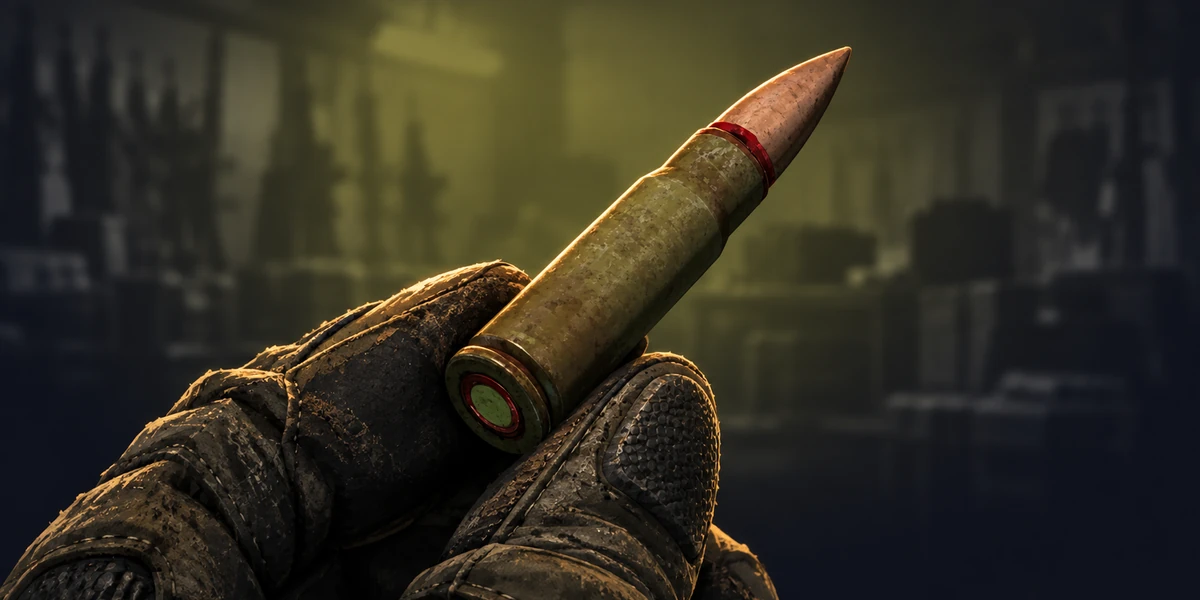
Pick ammo by penetration against the armor you expect to meet, then look at damage. Rounds around 30–39 penetration carry early raids, and 40+ is where class 4 armor stops being a wall. 7.62×39 PS, 5.56×45 M855 and 7.62×51 BCP FMJ are the simplest starting points, and 9×19 AP 6.3 is the first serious SMG upgrade.
Buy Escape From Tarkov Ultimate Pack
Prown the Tarkov!

Page updates
October 26, 2026
- How armor and penetration work: Whether a round gets in is a roll built from the armor's protection class, its remaining durability percentage and the ammo's penetration power.
How armor and penetration work
Any Tarkov ammo guide has to start with armor, because armor decides whether your damage number ever matters.
Armor in Tarkov does not shave a percentage off damage the way most shooters do — it stops the bullet outright or lets blunt damage through. Whether a round gets in is a roll built from the armor's protection class, its remaining durability percentage and the ammo's penetration power.

Impact angle does not change that roll, with one exception: helmets can ricochet bullets within a range of angles set by the helmet itself. A ricochet counts as the helmet stopping the round, and the blunt and durability damage that follow are tiny.
A round that penetrates still loses damage, between 0% and 40%, based on its penetration value against the armor's class and durability. Most penetrations land near 20% reduction when a bullet first starts going through, and higher penetration chances mean less reduction — a PACA hit by 5.56×45 M995 takes 0%.
A round that fails to penetrate applies blunt damage, a share of its base damage set by the armor's blunt throughput, the ammo's penetration value and the armor's class and durability. Blunt damage is very low and rarely decides a kill.
Every layer a bullet passes through costs it penetration power and damage, and speed lost to air friction over distance costs both again. Armor takes at least 1 durability damage per hit, buckshot pellets included, and a penetrating round usually does 10–15% less durability damage than one that does not get through.
Reading a penetration chart
Charts rate each round against armor classes 1 through 6. A 6 means it usually ignores that armor class; a 0 means it cannot get through in any reasonable number of hits.
| Level | Bullets stopped | Meaning |
| 0 | 20+ | Pointless against that armor class |
| 1 | 13 to 20 | Barely penetrates, or only after a long string of hits |
| 2 | 9 to 13 | Magdump only; very low chance that climbs slowly |
| 3 | 5 to 9 | Low chance, or chews durability until it gets through |
| 4 | 3 to 5 | Low-medium chance that rises quickly |
| 5 | 1 to 3 | Penetrates most of the time, often above 90% |
| 6 | under 1 | Penetrates more than 80% of the time from the first shot |
These counts assume every projectile hits, and because each projectile strips at least 1 durability, sustained fire eventually breaks armor down.
What penetration to aim for by armor class
Below 20 penetration is for exposed body parts and builds designed around them. For early raids the practical budget band is roughly 30–39, which helps without guaranteeing a quick breakthrough against every vest.
| Armor class | Penetration to aim for | What it means in a raid |
| 2 | Any ordinary round | Works when you hit the chest and give the target no time to answer; rare ammo here is wasted |
| 3 | About 30 or higher | The first class where weak rounds fail visibly; still check the caliber and its chance |
| 4 | 40 or higher | Reliable against healthy class 4; below that, take a fast-firing gun and accept extra hits |
| Heavier fights | 50+ | Rounds intended for heavier engagements |
Class 3 wants ammunition around 30 penetration or more, and 7.62×39 PS, M855 and 5.45 PP form a reasonable base there — distance, armor type and hit count still decide the outcome. Against class 4, 5.56 M856A1, M855A1, 5.45 BP, 7.62×39 BP and 7.62×51 M80 are more sensible than their weaker counterparts when the raid is built around PvP.
Ammo by caliber
5.45x39mm
PP is the first usable budget option at 34 penetration and 51 damage. BT adds penetration at 37 and 54 damage but is a tracer, so the trail can give your position away. BP is far more comfortable against class 4 at 45 penetration and 48 damage, and BS at 54 and 45 is a large reserve to spend deliberately rather than on every Scav.
HP is a specialist round at 9 penetration and 76 damage, suited to exposed body parts or a leg build, not a substitute for armor ammunition. Igolnik reaches 62 penetration with 37 damage. 5.45 is worth running once PP, BT or BP is available; if only the weak rounds are accessible, another caliber gives a more predictable result.
5.56x45mm NATO
M855 sits at 31 penetration and 54 damage — fine for weak and medium armor while you learn the ADAR or M4, but not a class 4 killer. M856A1 is the first meaningful step at 38 and 52, and M855A1 at 44 and 49 is the strong class 4 option.
M995 reaches 53 penetration and 42 damage as expensive late progression, not a beginner purchase, and SSA AP pushes to 57 penetration with 38 damage.
7.62x39mm
PS is the default budget choice at 35 penetration and 61 damage, good in early raids against class 2–3 armor in an AKM or VEPR-136. It can pressure class 4 when the armor is already damaged or your hits are clean, but that is not a guarantee.
BP at 47 penetration and 58 damage is a real upgrade for raids about fighting geared players. HP has 80 damage but only 15 penetration, so it belongs to a deliberate leg or exposed-body plan. MAI AP tops the caliber at 58 penetration and 53 damage.
7.62x51mm NATO
This caliber gives strong damage even on budget rounds: BCP FMJ has 37 penetration and 83 damage, a solid base for the RFB, M1A and similar rifles. For class 4, M80 (43 and 80) is the obvious upgrade; M62 (42 and 82) leaves a tracer trail; M61 (60 and 73) offers high penetration, but its cost makes it unsuitable for any raid where you are learning.
M993 is the top of the line at 65 penetration and 70 damage. The caliber lets you end fights in few accurate hits; the trade-off is recoil, magazine size, ammo cost and stricter positioning.
9x19mm
Pst gzh at 20 penetration and 54 damage is cheap ammunition for Scavs, exposed areas and weak armor, not a reliable answer to a protected PMC. For the MP5, Vector and other 9×19 guns, AP 6.3 (30 and 52) is the earliest upgrade that makes sense; fire it in controlled bursts, not straight at heavy armor.
PBP gives 39 penetration and 44 damage, yet its cost has to suit your budget. QuakeMaker and RIP have high body damage — 85 and 102 — with 8 and 2 penetration, so they only work in a build designed around legs.
###.366 TKM
Geksa is the high-damage, low-penetration option at 110 damage and 14 penetration. FMJ gives 98 damage at 23 penetration and EKO 73 at 30, while AP-M is the armor answer at 90 damage and 42 penetration.
All ammo types in Tarkov

Every round belongs to a caliber, and the caliber decides which gun can chamber it. The groups look like this:
| Group | Calibers |
| Pistol | 7.62x25mm Tokarev, 9x18mm Makarov, 9x19mm Parabellum, 9x21mm Gyurza,.357 Magnum,.45 ACP,.50 Action Express, 20x1mm |
| PDW | 4.6x30mm HK, 5.7x28mm FN |
| Rifle | 5.45x39mm, 5.56x45mm NATO, 5.8x42mm, 6.8x51mm,.300 Blackout, 7.62x39mm, 7.62x51mm NATO,.308 Marlin Express, 7.62x54mmR,.338 Lapua Magnum, 9x39mm, 9.3x64mm,.366 TKM, 12.7x55mm,.50 BMG |
| Shotgun | 12/70, 20/70, 23x75mmR |
| Other | 30x29mm, 40x46mm, 40x53mm, 26x75mm, 12.7x108mm |
Buy Escape From Tarkov Veteran Pack
Just Survive!

Which guns take which caliber
- Pistol cartridges: 7.62x25mm Tokarev for the TT-33 and PPSh-41; 9x18mm Makarov for the PM, PB, APS, APB and Kedr family; 9x19mm for the Glocks, M9A3, MP-443 Grach, P226R, MP5, MPX, UZI and Vector 9×19.
- More pistol cartridges: 9x21mm Gyurza for the SR-1MP and SR-2M;.357 Magnum for the Desert Eagle L5.357 and CR 50DS;.45 ACP for the M1911A1, M45A1, USP.45, UMP 45 and Vector.45;.50 Action Express for the Desert Eagle.50 AE models.
- PDW cartridges: 4.6x30mm HK for the MP7A1 and MP7A2; 5.7x28mm FN for the FN 5-7 and P90.
- Shotgun cartridges: 12/70 for the AA-12, M3 Super 90, M590A1, M870, MP-133, MP-153, MP-155 and Saiga-12K family; 20/70 for the TOZ-106; 23x75mmR for the KS-23M.
- Grenade launcher and flare cartridges: 40x46mm for the FN40GL, M203 and M32A1, 30x29mm for the AGS-30, 40x53mm for the GP-25, and 26x75mm flares for the SP-81.

Popular rounds by role
| Round | Common guns | Why players pick it |
| 7.62x39mm BP | AKM, SKS | Armor-piercing mid-range round for mid-level play |
| 5.56x45mm M855A1 | M4A1, HK416 | Balanced penetration and damage, reachable early |
| 7.62x51mm M61 | DVL-10, M700 | Long-range penetration that goes through high-level armor |
| 12/70 flechette | Shotguns | Turns a shotgun into a close-range armor shredder |
| 9x19mm AP 6.3 | MP5, P226 | The first serious 9×19 step for SMGs and pistols |
Where to get ammo
Looting is the free route: Interchange for hidden stashes, Reserve for military crates, ammo boxes and raider gear.
- Prapor: 7.62x39mm, 5.45x39mm, 9x18mm, 7.62x54mmR and 9x19mm.
- Peacekeeper: 5.56x45mm, 9x19mm,.45 ACP and 7.62x51mm.
- Mechanic:.366 TKM, 9x39mm and 12.7x55mm.
- Jaeger: 12ga, 20ga and.300 Blackout.
- Skier: 7.62x25mm Tokarev and 5.7x28mm.
- Flea market: any round in the game, at a premium.
- Hideout: crafting a range of rounds once your upgrades allow it, including 5.56x45mm, 7.62x51mm and 9x39mm.
Buy Escape From Tarkov Starter Pack
Prepare for the Epic Battle!
Visible ammo stats
| Stat | What it tells you |
| Armor Penetration | How well the round punches through armor |
| Damage | Hit points removed from an unarmored target |
| Bullet Speed | Higher speed means less drop over distance |
| Tracer | Lights up your shots and gives away your position |
| Recoil | How much the gun kicks; lower keeps your aim on target |
| Accuracy | Bullet spread; higher accuracy tightens your group |
| Ricochet Chance | Odds the round bounces instead of penetrating |

Hidden ammo stats
| Hidden stat | What it does |
| Fragmentation Chance | Chance the bullet breaks apart on impact for extra damage |
| Armor Damage Ratio | How much damage the round does to armor when it fails to penetrate |
| Heat Generation | How much the weapon heats up, which feeds malfunctions |
| Durability Burn | How much weapon durability each shot costs |

Durability damage from a hit is the ammo's penetration value and the armor's level, multiplied by the ammo's armor damage percentage and the armor material's destructibility. Destructibility is hidden in game and runs from 0.1875 for aramid, through 0.4125 for titan and 0.525 for armor steel, to 0.6 for ceramic and glass.
Ammo containers and storage
| Container | Capacity | Use |
| Ammo Case | 49 slots (7×7 grid) | Stores a large variety of ammo types in a compact space |
| Magazine Case | 64 slots (8×8 grid) | Holds pre-loaded magazines ready to swap |
| Lucky Scav Junkbox | 196 slots (14×14 grid) | Holds ammo alongside other miscellaneous loot |
| THICC Items Case | 196 slots (14×14 grid) | Premium storage for ammo, weapons and other gear |
Buy Escape From Tarkov Leveling
Become the Best In the Tarkov!

Buying order before a raid
- Pick a weapon you can replace after a death instead of stocking every caliber at once.
- Decide what the raid is for: a quest or loot run can take a cheaper round, while a PvP raid needs enough penetration for the armor you expect.
- Compare penetration before price, because a much weaker cheap round costs you extra hits, longer fights and more risk.
- Buy two or three raids of one round type so you learn the recoil, distance and hit count of a single load.
- Check trader stock and purchase limits before paying a flea premium, and compare price per round rather than price per pack.
- Upgrade only when a clearly stronger round unlocks at a reasonable price, not because it sits higher on a list.
When learning, carry 150–200 rounds of a single reliable type rather than five mixed stacks, and avoid mixing weak with strong rounds in one magazine unless there is a clear reason.
Common mistakes
- Buying by damage: a high-damage, low-penetration round does not solve armor fights.
- Bringing leg ammo to a regular fight: QuakeMaker, RIP and HP function only in a setup built around exposed body parts.
- Running the weakest 5.45 round: a good rifle cannot fix bad ammunition, and another caliber may be more predictable.
- Overpaying on the flea immediately: trader stock and limits come first, and the difference buys armor, meds and spare magazines.
- Chasing one distant ammo pack: extracting alive is usually worth more than the detour.


Frequently Asked Questions
Does the gun change how much damage a bullet does?
No. Damage comes from the bullet itself, not from the weapon that fired it.
Is 5.45×39 worth using as a beginner?
Yes, when PP, BT or BP is available; if only the weak rounds are accessible, another caliber gives a more predictable armor result.
Should I buy ammo on the flea market?
Not automatically. Check trader stock and the purchase limit first, then compare price per round on the flea, since the premium only pays off when it gets you the round you need.
When should I use high-damage, low-penetration ammo?
Use it only if you intentionally target the legs or uncovered body areas; in standard chest engagements, take a round with sufficient penetration.