Updated October 29, 2026 for the run-up to the WoW Forever launch on November 4, 2026. The tiers follow test-build tuning and early PvE rankings and change with each class tuning pass.
Hunters, Warlocks and Enhancement Shaman are the leading picks in this WoW Forever DPS tier list for level-30 beta PvE. Hunters excel on smaller pulls, while Mages and Warlocks deliver exceptional area damage in this bracket. Treat these results as preparation rather than a prediction of your finished character's performance.
WoW Forever DPS Tier List: Level-30 Beta PvE Before Launch
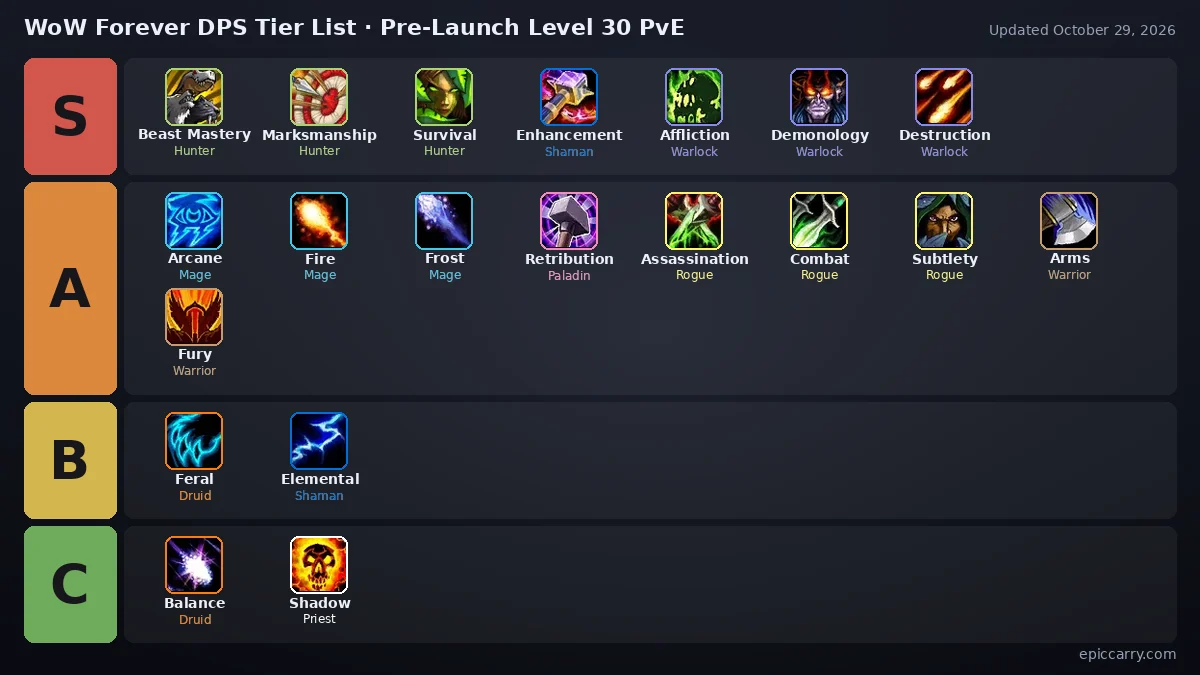
The tier table below as a board. Icons: Blizzard.
| Tier | Specs |
| S | Beast Mastery Hunter, Marksmanship Hunter, Survival Hunter, Enhancement Shaman, Affliction Warlock, Demonology Warlock, Destruction Warlock |
| A | Arcane Mage, Fire Mage, Frost Mage, Retribution Paladin, Assassination Rogue, Combat Rogue, Subtlety Rogue, Arms Warrior, Fury Warrior |
| B | Feral Druid, Elemental Shaman |
| C | Balance Druid, Shadow Priest |
WoW Forever launches on November 4, 2026, at 3:00 p.m. PST; the beta ran from September 17 through October 23, 2026, PDT. Use the WoW Forever release date guide to plan your start.
S Tier
These picks combine the Hunter's strength against small groups, the Warlock's area damage, or Enhancement's strong overall level-30 PvE assessment.
Beast Mastery Hunter
Beast Mastery benefits from a Hunter damage profile that excels when you fight only a few enemies at once, with weaker performance on large packs. At level 30, the assessment largely reflects the shared class toolkit because specialization differences remain limited. Favor it when your group prefers controlled pulls.
Marksmanship Hunter
Marksmanship shares the Hunter advantage on pulls of two or three enemies rather than on large area-damage pulls. Hunter utility also includes Tranquilizing Shot for removing an Enrage and Freezing Trap for controlling an enemy until damage breaks the effect. Match your choice to the pulls you actually enjoy playing.
Survival Hunter
Survival shares the class's strong small-pull performance in the level-30 beta assessment. The distinction between Hunter specializations is still limited in this bracket, so the class's weaker area damage remains the relevant trade-off. Choose around your preferred play style rather than assuming the specialization name guarantees a different dungeon damage profile.
Enhancement Shaman
Enhancement stands out in a level-30 environment that generally favors physical damage over caster damage. Shaman support includes Strength of Earth Totem for Strength and Windfury Totem for enhancing allies' melee attacks, making that utility particularly useful alongside melee characters. Consider the group you want to support as well as your own damage.
Affliction Warlock
Affliction shares the Warlock class's exceptional area damage at these early levels. Damage-over-time effects and area-damage cooldowns are important ways casters remain competitive at level 30, with wand attacks filling much of their dungeon time. Plan around the whole pull rather than judging the choice only by a short burst window.
Demonology Warlock
Demonology benefits from the same strong early-level Warlock area-damage profile, with limited specialization separation in this bracket. The wider Warlock toolkit adds Soulstone for combat resurrection and a Felhunter option with Spell Lock and Devour Magic. Weigh that support alongside damage when choosing your character.
Destruction Warlock
Destruction shares the Warlock class's powerful area damage in the level-30 beta comparison. Warlocks also provide Curse of the Elements, which lowers Magic Resistance and increases incoming magic damage, while Banish controls Demons and Elementals. Think about what the group needs beyond your own damage total.

A Tier
These specs offer competitive level-30 PvE choices, with pull size particularly important for Mages and the broader bracket generally favoring physical damage.
Arcane Mage
Arcane benefits from the Mage class's outstanding early-level area damage, but small pulls undermine that advantage. Against groups of only two or three enemies, the Mage falls behind the stronger small-pull choices. Ask how aggressively your group intends to pull before building your choice around area damage.
Fire Mage
Fire shares the Mage class's high area-damage potential in the level-30 comparison. The bracket still offers limited differences between most specializations, so this assessment largely reflects the class rather than a distinct Fire-only advantage. Judge your expected pull pattern before committing to a damage profile.
Frost Mage
Frost shares the same early Mage strengths on larger packs and the same disadvantage when groups keep pulls small. Casters at level 30 often rely on valuable damage-over-time effects or area cooldowns before spending substantial dungeon time attacking with a wand. Consider the pace between strong damage windows as part of your choice.
Retribution Paladin
Retribution fits a level-30 field in which physical damage generally performs well. Paladin support includes Cleanse against Poison, Disease and Magic effects, plus Blessing of Protection against physical attacks, although the protected character cannot attack or use physical abilities. Use that protection with its trade-off in mind.
Assassination Rogue
Assassination benefits from the broader strength of physical damage in the level-30 beta, where most specializations remain close to their class counterparts. Treat that class-level assessment as a starting point for choosing a Rogue play style. Rogue's beta treatment feels neglected to one player, who puts it this way.
Rogue is the most negleted class in wow forever.
— one player
Combat Rogue
Combat sits within the physical-damage group that generally fares well at level 30. Specialization differences are limited in this bracket, so the assessment represents Rogue as a class more than a sharply separated Combat damage profile. Choose the approach you want to practice rather than treating this comparison as a permanent verdict.
Subtlety Rogue
Subtlety shares the Rogue class's favorable physical-damage context at level 30. The early bracket does little to separate most specializations, so the class-level result carries more weight here than a distinct Subtlety advantage. Start with the play style you prefer and reassess as your character develops.
Arms Warrior
Arms benefits from a level-30 environment in which physical damage generally outperforms caster damage outside the standout classes. The comparison largely represents Warrior as a class because most specialization differences are still small at this level. Use the Mythic Sim WoW Forever guide when you want to explore comparisons for your own setup.
Fury Warrior
Fury shares the Warrior class's favorable position within the physical-damage-heavy level-30 environment. The bracket offers limited separation between most specializations, so it does not establish a decisive Fury-versus-Arms damage distinction. Let your preferred play style guide that choice.
B Tier
These specs occupy a less favorable overall level-30 PvE position than the leading damage choices.
Feral Druid
Feral's overall level-30 assessment trails the leading physical-damage options despite the bracket's general preference for physical damage. That comparison considers damage, group benefits, emergency assistance and defensive tools together. Weigh the complete role you want to play rather than assuming a physical damage profile settles the decision.
Elemental Shaman
Elemental competes in a level-30 environment that generally favors physical damage over caster damage. Shaman utility includes Tremor Totem against Fear, Charm and Sleep, alongside Mana Spring Totem for party mana recovery. Elemental's damage feels too weak and needs substantial help in the view of many players discussing it.
C Tier
These caster choices face the toughest overall level-30 PvE assessment, with Balance further limited by its lack of a wand option.
Balance Druid
Balance cannot fall back on wand attacks, unlike the caster approach that helps bridge damage windows in this bracket. Its overall level-30 assessment consequently sits behind the other listed damage choices. Consider how comfortable you are with that early-level limitation before choosing it for damage alone.
Shadow Priest
Shadow faces a level-30 environment where physical damage generally performs better and casters frequently depend on damage-over-time effects, area cooldowns and wand attacks. Its overall assessment places it among the weakest options for this specific beta bracket. Keep the early-level comparison separate from your long-term character preference.

Frequently Asked Questions
Does this predict launch endgame damage?
Use it as an early-level comparison. The damage assessment is restricted to the level-30 beta, and important abilities and talents are still missing at that cap compared with level 60.
Should you choose a Mage or Hunter for dungeon damage?
Hunters are particularly effective on smaller pulls, while Mages gain much more from large groups that let their area damage matter. Choose the damage profile that matches your group's pulling habits.
Can you judge a spec from one simulation or dungeon log?
Treat either as one input. Beta simulations can omit mechanics, while dungeon results vary with equipment, group composition, encounter length and bugs.